Curriculum
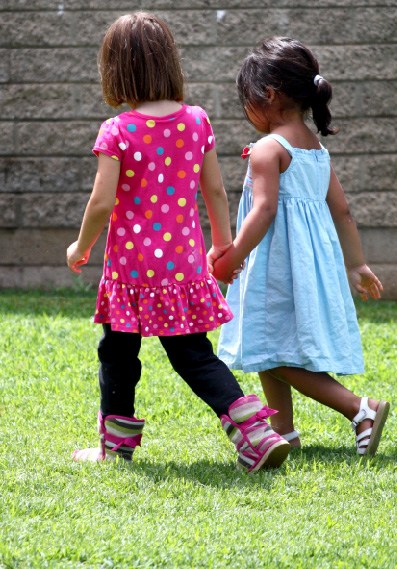 The curriculum used by RSCCD Child Development Services is the High Scope Curriculum, which is based on active learning. We believe that children learn best through hands-on experiences with people, materials, events, and
ideas. That principle — validated by decades of research — is the basis of High Scope's
approach to teaching and learning. High Scope provides a balance of child-initiated and teacher-lead activities. During
a portion of the day, children have the opportunity to choose their own materials,
activities, and play partners based on their individual stage of development. The
children discover and learn by making the decisions they need to work through an activity
and communicate verbally and non-verbally what they are doing and understanding. The
RSCCD Child Development Center teachers support the children's current level of thinking
and challenge them to advance to the next stage through support and differentiated
Instruction. Through the use of the California Preschool Foundations and the Desired
Results Developmental Profile (an authentic standardized assessment tool), teachers
assess and design learning experiences that encourage further development of each
child's developmental level.
The curriculum used by RSCCD Child Development Services is the High Scope Curriculum, which is based on active learning. We believe that children learn best through hands-on experiences with people, materials, events, and
ideas. That principle — validated by decades of research — is the basis of High Scope's
approach to teaching and learning. High Scope provides a balance of child-initiated and teacher-lead activities. During
a portion of the day, children have the opportunity to choose their own materials,
activities, and play partners based on their individual stage of development. The
children discover and learn by making the decisions they need to work through an activity
and communicate verbally and non-verbally what they are doing and understanding. The
RSCCD Child Development Center teachers support the children's current level of thinking
and challenge them to advance to the next stage through support and differentiated
Instruction. Through the use of the California Preschool Foundations and the Desired
Results Developmental Profile (an authentic standardized assessment tool), teachers
assess and design learning experiences that encourage further development of each
child's developmental level.
The High Scope Curriculum and the California Preschool Learning Foundations guide learning opportunities in these domains:
Children are encouraged to build their verbal expression and comprehension with many opportunities to engage in conversations with adults and peers. Literacy skills are promoted through a print rich environment and activities that promote phonological awareness, alphabet knowledge, and concepts about print.
Children develop a number sense by actively participating in real life mathematical experiences and with a variety of materials that build math skills, such as counting, sorting, matching, shape recognition, spatial recognition and patterns.
Children learn by exploring the world around them. We nurture children's natural curiosity and intrinsic need to discover by offering them opportunities to use their five senses through observing, classifying, experimenting, comparing, questioning, predicting and analyzing results.
Children explore roles and relationships through formal and informal classroom activities and lessons that help them to recognizing diversity, community roles, decision making, and social expectations.
Children are encouraged to develop a healthy self-identity, sense of competence, and self-regulation through relationship building, cooperative play and conflict resolution.
Children are provided opportunities to engage in physical activities that promote their large and small motor skills through the use of materials and equipment such as slides, balls, climbing structures, bicycles, scissors, play dough, paint, puzzles, and lacing cards.
Children are given opportunities to make healthy food choices and develop personal care routines that promote healthy practices.
Children are encouraged to express their creativity throughout the day by participating in art, self-expression, music, and pretend play activities.